
Success is like Tetris
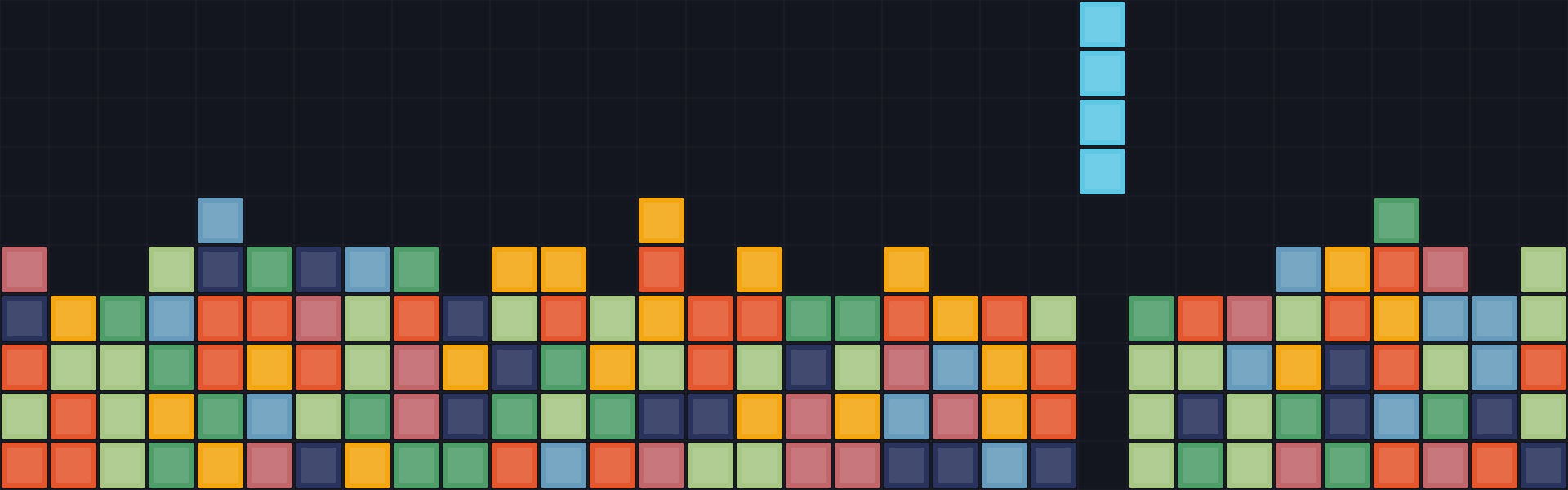
If you’ve ever played Tetris you know this feeling.
The stack is getting high. You’ve left one column open down the side, a nice deep well, and you’ve been filling in everything around it for what feels like forever. Three rows. Four rows. Everything tidy, everything ready. Now you’re just waiting for the long straight piece.
Then it turns up. You drop it in, and four lines vanish at once.
That’s what success looks like from the inside. Not a smooth line up and to the right. A long stretch of stacking where nothing seems to happen, and then everything clears in one go.
A full row is worth nothing until it’s full
Here’s the brutal bit, and it’s the first thing Tetris teaches you: a row that’s nine-tenths full is worth exactly the same as an empty one. Nothing. It doesn’t clear. It doesn’t score. It just sits there, taking up space and looking like wasted effort.
That’s most of the work you’ll ever do on anything worth doing. The business that’s got the product but not the customers. The skill you’re competent at but not yet good at. The book with forty chapters and holes between them (hello). It’s all nine-tenths-full rows, and from the outside it looks identical to not having started.
There are almost no overnight successes. What there is, is a lot of people who stacked for years where nobody could see it, and then had one very visible afternoon. Everyone sees the lines clear. Nobody sees the stacking.
And learning works exactly the same way. It doesn’t come in a smooth line - it comes in bursts, with long flat stretches in between. The flat stretches are where most people quit, because a nearly-full row feels like failure right up until the moment it isn’t.
The long piece is worth more than you think
In the original Nintendo Tetris, clearing one line scores 40 points. Clearing four at once - an actual Tetris - scores 1,200.
Do the maths on that. Four single lines, one at a time, gets you 160. The same four lines cleared together gets you 1,200. Same lines. Same pieces. Seven and a half times the reward.
The game is quietly telling you something true about the world: the payoff isn’t linear. Work that lands all at once is worth dramatically more than the same work dribbled out piece by piece.
You see it everywhere once you look. Money compounds - the returns in year twenty dwarf the returns in year two, on the same savings. A developer who also understands sales doesn’t get a bit more valuable, they get a different job entirely. Two skills that stack together clear rows neither one could clear on its own. Reputation is the same - years of quietly doing what you said you’d do, and then one day people start sending you work you never asked for.
The catch is you have to be willing to not take the small, easy clear. And that’s harder than it sounds.
Leave the well open
Every good Tetris player has the same habit: they keep one column empty. The well. It’s the thing that makes the big payoff possible at all.
And every single piece that comes down wants to go in it.
That awkward S-shape you don’t know what to do with? Drop it in the gap. Instant relief. Problem gone. Except now your well is blocked, the long piece has nowhere to land, and you’re back to scraping out lines one at a time.
There’s a chapter in my book about this, called holding space. The short version: you have to create space in your life, usually by dropping something, and then - the hard part - hold it open. A space is a vacuum, and life will try to fill it. The evening you kept free for the project fills with a show. The savings you were building for the leap fills with a nicer car. The quiet hour fills with your phone.
The opposite of holding space is what I call running poor. It’s a board with no well. Every piece goes wherever it fits right now, you’re always one bad drop from the top, and all you can ever do is clear singles to survive. It’s not a character flaw, and it’s not about how smart you are. It’s just very hard to play well when you’ve got no room to move.
You don’t pick the pieces
Nobody gets the pieces they want. You get S-pieces and Z-pieces, the ugly ones that never sit flat. You get a bad boss, a redundancy, a market that turns, a kid who doesn’t sleep for two years.
The skill in Tetris isn’t getting good pieces. It’s placing ugly ones cleanly.
And notice how far ahead you can actually see. The original game showed you exactly one piece coming next. Not ten. One. You plan with what’s in the preview window, and you keep your board flexible enough to handle whatever turns up after that. The people who struggle are the ones who build a plan that only works if the next six pieces are exactly the right shape, and then take it personally when they’re not.
Holes are what actually kill you
Here’s something that surprised me: people rarely lose at Tetris because of bad luck. They lose because of holes.
A hole is what happens when you drop a piece carelessly and leave a gap underneath it, covered over. It doesn’t look like much. But now every row with that gap in it can’t clear until you dig down to it, and everything you stack on top makes the dig deeper.
That’s avoidance, exactly. The hard conversation you covered over. The bill you didn’t open. The skill you skipped because it was boring. The problem doesn’t sit still underneath - it locks up every row above it. You can build as high as you like, and none of it will ever clear.
The book puts it more bluntly: a crisis is almost always a small problem you fed with time. Dig out holes while there’s only one row on top of them. It’s a small job then. Leave it, and it’s the job that ends the game.
The drought
Competitive players have a name for a long stretch where the straight piece just doesn’t come. A drought.
It’s horrible. The stack keeps rising. Your nice tidy board starts creeping towards the top. You start doubting the whole strategy - maybe the well was a stupid idea, maybe the piece is never coming, maybe you should just fill it in and give up on the big clear.
This is where the fun part of the analogy has to get honest, because sometimes the long piece doesn’t come in time.
Good players know this. When the stack gets too high they burn - they take the ugly singles and doubles, bring the board back down, and live to build again. It’s not glamorous. It scores badly. But the player who refuses anything less than a Tetris doesn’t win more - they top out, with a beautiful, empty well and a game over screen.
So take the contract work. Keep the day job a bit longer. Take the small win that keeps you in the game. That’s not giving up on the big clear, it’s buying time to get one. You don’t need every move to be a perfect one - you need to get it right slightly more often than you get it wrong. Fifty-one percent, over a long enough game, is plenty.
And know your stack height. How long you can afford to wait for the long piece depends entirely on how much room is left above you. Savings, health, the patience of the people around you - that’s your headroom. Build it when things are going well, because you’ll need it in the drought.
Then it clears, and the pieces get faster
Here’s the part nobody tells you about the big clear.
The reward for a Tetris is an emptier board. The lines you spent all that time building don’t get framed and hung on the wall. They just disappear. And then the level ticks up, and the pieces start falling faster.
That’s success, too. You hit the thing, and for about an afternoon it feels incredible. Then you get used to it, because you get used to everything, and you’re standing on a clean board with a harder game in front of you. People who were playing for the clear find that genuinely crushing. They go back and try to recreate the magic, and it never works, because nothing stays the same.
But if you actually like the stacking - the placing, the planning, the ugly pieces tucked in cleanly - then an empty board at a faster speed is the best news there is. It means you get to keep playing, and you’re better at it than you were.
The bottom line
Success mostly looks like nothing. Rows that don’t clear, a well you’re refusing to fill, and a long wait for a piece you can’t control. Then it all goes at once, and the people watching call it luck.
So keep the well open. Place the ugly pieces cleanly. Dig out the holes while they’re small. Burn a few lines when you have to, without taking it personally. And learn to enjoy the stacking, because that’s most of the game.
The long piece is coming. It always does, eventually. The only real question is whether you’ve still got a board ready for it when it arrives.